
Item
Person
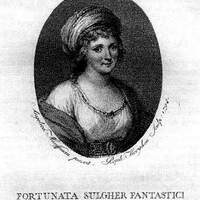
Sulgher-Fantastici, Fortunata

- LOC Authority File
- Sulgher Fantastici, Fortunata, 1755-1824
- Pseudonym
- Temira Parraside (Arcadian name)
- Lifespan
- 1755-1824
- Generation
- 1780–1819
- Historical context
- Pre-Risorgimento Generation
- Country of origin
- Italy
- Language
- Italian
- Education
- Home schooled and privately tutored
- Religion
- Catholic
- Occupation
- Poet
- Member of the Arcadia from 1770
- Member of Reale Accademia Fiorentina di Belle Lettere
- Ex-tempore poet (poetessa improvvisatrice)
- Short biography
-
Fortunata Sulgher Fantastici was born in Livorno on February 27, 1755, to Elisabetta Angeli from Pisa and Francesco Sulgher from Livorno. She demonstrated remarkable poetic talent from an early age, beginning to improvise verses at just ten years old under the initial guidance of Doctor Loggia. Although her parents could not provide her with renowned teachers, by age thirteen she was already composing her own poetry. Her youthful improvisations gained early recognition, with contemporary poet Pentolini celebrating her precocious talent.
She pursued her education with determination, studying physics under the celebrated Attilio Zuccagni and Greek with Abbot Fontani. Her literary development was supported by influential patrons including Balì Lorenzo Ottavio del Rosso, Marchesa Viviani, Contessa Acciaiuoli, and the Duchess of Atri.
Sulgher Fantastici married Giovanni Fantastici and bore seven children in the first ten years of marriage, though tragically she lost five of them in early childhood. Her surviving daughters were Isabella, who married Giovanni Battista Kiriaki in Venice and later became director of the women's college in Montagnana where she died in 1832, and Massimina, herself a celebrated writer and poetess who married the nobleman Luigi Rosellini. After being widowed and seeing both daughters married, Fortunata entered a second marriage with Pietro Marchesini.
In 1770, she was admitted to the prestigious Accademia dell'Arcadia under the pseudonym Temira Parraside. Her first publication appeared in 1785 when some of her verses were featured in the Bolognese journal Parnaso Italiano.
She regularly recited her poetic compositions at the Royal Florentine Academy of Fine Letters, where commentators praised her exceptional merit, noting that she brought honor to her homeland and her gender, advancing boldly on the glorious path of Tuscan poetry when Florence's poetic voices had largely fallen silent.
In 1783, she met the renowned poet Vincenzo Monti, who became a frequent visitor to the Fantastici household. In 1785, the Florentine publisher Pietro Allegrini released her first complete work, titled Componimenti Poetici di Temira Parraside per l'Accademia Fiorentina. The publication immediately garnered acclaim, with poetess Costanza Moscheni dedicating an Anacreontic ode to her praising her charming imagery. She enjoyed friendships with celebrated poets of her era including Cesarotti, the two Pindemonte brothers, and Bondi. She performed alongside distinguished poets such as Mazzei, Benedettini, Biamonti, Duke Mollo, Lorenzi, and even with Gianni, considered the prince of Italian improvisers, despite his having written some injurious verses directed at her.
Continuing under her Arcadian pseudonym, she published additional collections of poetry in 1792 with Stamperia Pazziniana and in 1794 with the Livorno publisher Tommaso Masi & Co. Notable works from this period include Per l'Espugnazione di Mantova, Canto per fanciulli di un Istituto, and Amerigo. Further collections appeared in Florence in 1796, and in 1802 she published the poem Ero e Leandro in Parma.
She died suddenly in Florence on June 13, 1824, and was buried in the first cloister adjacent to the Church of Santa Croce, with a Latin epitaph composed by Giovanni Zannoni celebrating her charitable nature and compassion for the poor. -
C. GIOTTI, Elogio di Fortunata Sulgher Fantastici Marchesini poetessa estemporanea, fra gli
Arcadi Temira Parraside, Firenze, Stamperia Magheri, 1824. -
J. DE BLASI, Antologia delle scrittrici italiane dalle origini al 1800, Firenze, Nemi, 1930, pp.
468-78.
J. DE BLASI, Le scrittrici italiane dalle origini all’Ottocento, Firenze, Nemi, 1930, pp. 271, 281,
285, 186.
T. CRIVELLI, La sorellanza nella poesia arcadica femminile tra Sette e Ottocento, in «Filologia e
critica», XXVI, fasc. III, 2001, pp. 321-349. - Selected List of Publications
- (1785) Componimenti poetici, Firenze, Allegrini.
- (1791) Componimenti poetici, Parma, Carmignani.
- (1794) Poesie, Livorno, Masi e Compagni, 1794.
- (nd) 'Se d'Alighieri l'anima immortale', Poesie, Livorno, Masi e Compagni, 1794.
- (1802) Ero e Leandro. Poemetto, Parma, Co’ Tipi Bodoniani.
- (1804) La morte di Abele. Tragedia di Temira Parraside, Firenze, Domenico Ciardetti, 1804.
- Link to external sources
- Fondo Fortunata Sulgher Fantastici, Biblioteca Centrale Nazionale, Florence
Linked resources
'Se d'Alighieri l'anima immortale'
Item
Book Section
- Resource class
- Person
Part of Sulgher-Fantastici, Fortunata
Annotations
There are no annotations for this resource.
Position: 1163 (4 views)